As goes the American economy, so goes the traffic.
Though it might have been hard to notice, traffic congestion took a break from its worsening trend even before the current recession, with high gas prices in the last half of 2007 bringing about a slight reduction in traffic. The recession that took hold soon after could prolong that effect, but experts warn that the slowdown in congestion growth will be temporary. When the economy rebounds, expect traffic problems to do the same.
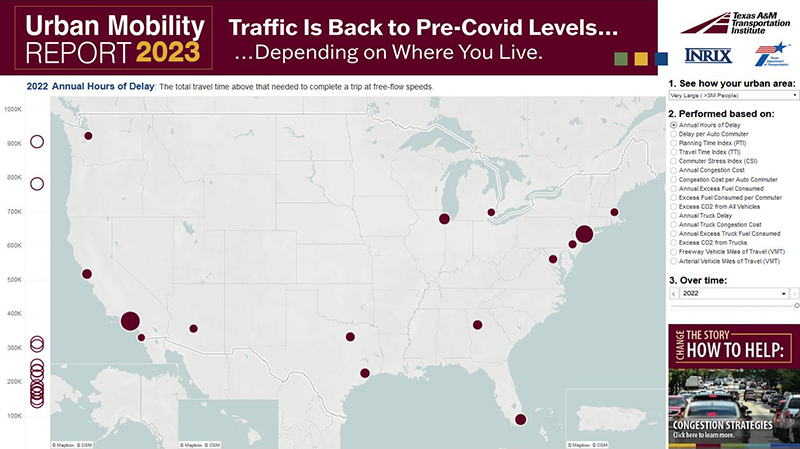
The most current information on the nation's traffic picture is outlined in the 2009 Urban Mobility Report, published recently by the Texas Transportation Institute. This year's installment tracks a quarter century of traffic patterns in 439 U.S. urban areas from 1982 through 2007. The report was prepared by researchers David Schrank and Tim Lomax.
Travelers spent one hour less stuck in traffic in 2007 than they did the year before and wasted one gallon less gasoline than the year before. The differences are small, but they represent a rare break in near-constant growth in traffic over 25 years.
"This is a very small change," says Schrank. "No one should expect to be driving the speed limit on their way to work because of this." That's because the average traveler still needs 25 percent more time for those trips.
Other highlights from the research illustrate the effects of the nation's traffic problems.
Researchers recommend a balanced and diversified approach to reducing traffic congestion – one that focuses on more of everything. Their strategies include:
"The best solutions are going to be those in which actions by transportation agencies are complemented by businesses, manufacturers and commuters," Lomax says. "There's a mindset that says that this is a city government's job or a state DOT's job, but the problem is far too big for transportation agencies alone to address it adequately."
And even though the problem has leveled off somewhat, we shouldn't expect it to be a trend, the researchers say, because an otherwise steady trend over 25 years has been interrupted only by – you guessed it – a recession. "The northeastern states and Texas in the mid-1980s and California in the 90s are three regions that give us an idea what to expect," Lomax says. "In each of those cases, when the economy rebounded, so did the traffic problem."
The Texas Transportation Institute, founded in 1950, is an agency of the Texas A&M University System.